
French President Emmanuel Macron on Sunday addressed the nation to voice what he termed the public’s “anger and shame” following widespread rioting, arson, and looting during nationwide protests over escalating living costs and deteriorating conditions in public schools. Interior Ministry officials confirmed that police detained at least 2,400 individuals across the country during the weekend unrest.
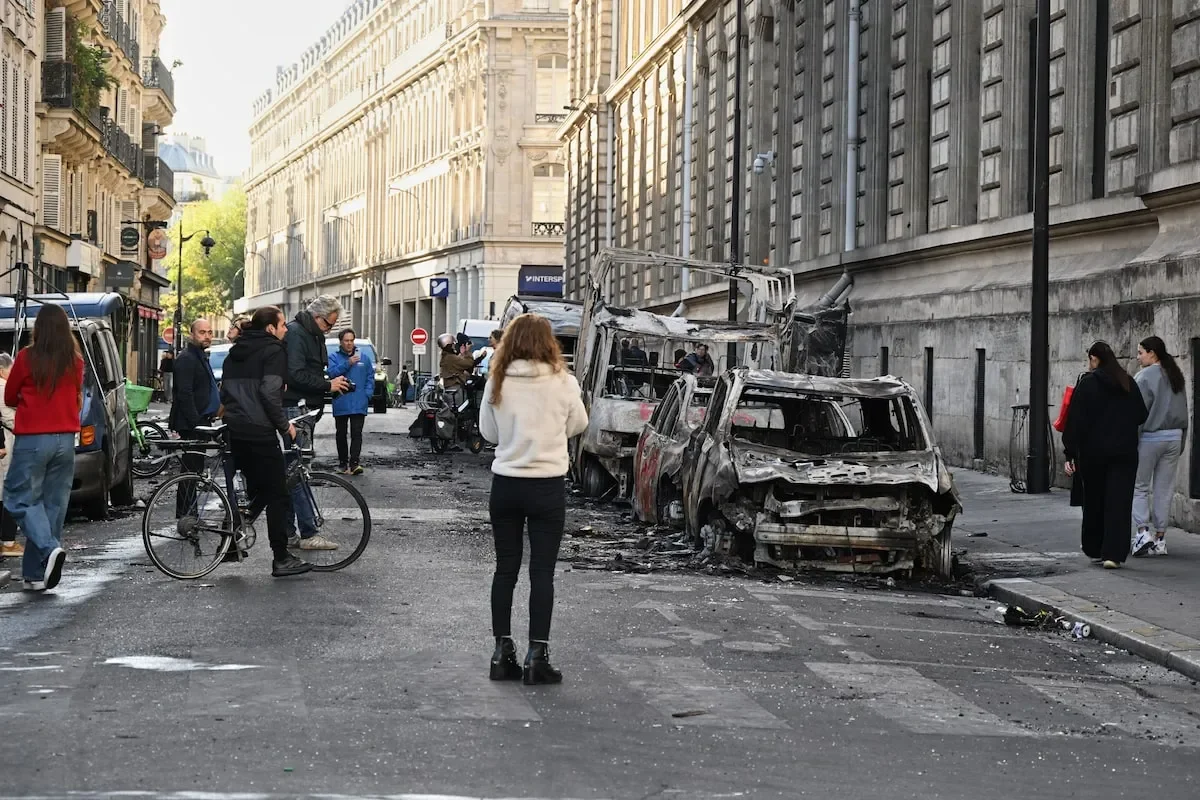
In a televised address, Macron condemned the escalation, attributing significant destruction to radical elements operating on the fringes of organized labor rallies.
“Those who looted will have to pay for the damage, and those who sought to bring down the Republic will be held accountable,” Macron stated. The president denounced what he described as “unrestrained violence by insurrectionist elements from radical far-left groups, joined by numerous criminals.“
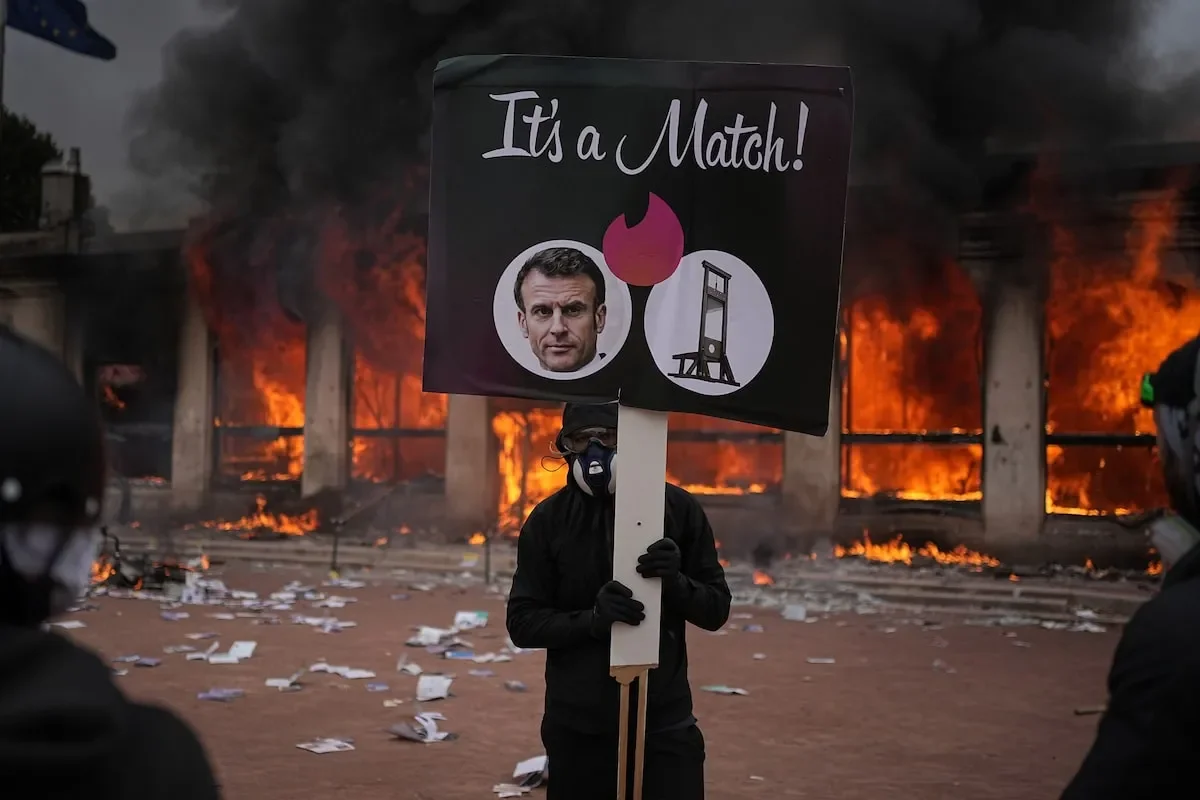
Earlier in the day, Macron convened an emergency cabinet session after masked factions set fires and targeted municipal government centers. The president instructed regional prefects to coordinate directly with local mayors to reinforce public infrastructure and commercial corridors, authorizing localized protest bans where security risks warrant.
National Turnout, Damage, and Arrest Statistics
The weekend demonstrations represented one of the most volatile domestic security challenges in France in recent years, drawing comparisons in scale to the 2018 Gilets Jaunes (Yellow Vest) mobilization:
| Indicator | Official Government Data | Organizer / Municipal Reports |
| Demonstrator Turnout | 550,000 nationwide | 800,000 estimated by labor unions |
| Total Arrests Nationwide | At least 2,400 detentions | — |
| Paris Regional Arrests | 855 detained; 557 remanded to custody | Widespread damage across tourist corridors |
| Municipal Target (Limoges) | 19th-century City Hall set on fire | Roof collapsed; extensive interior loss |
| Municipal Target (Marseille) | City Hall lobby breached | Local police station damaged |
| Municipal Target (Lyon) | Fire set inside municipal tourist office | Commercial storefronts vandalized |
The most severe architectural destruction occurred in central France, where flames engulfed the 19th-century City Hall in Limoges. Haute-Vienne Prefect Maurice Barate reported that individuals forced entry while municipal employees and security personnel were inside, deliberately igniting the structure and causing the main roof to collapse.
Escalations in Paris and Public Reaction
On Sunday, hundreds of demonstrators gathered again at Paris’s Place de la République under a heavy deployment of riot police. Security personnel deployed tear gas periodically to disperse decentralized crowds attempting to barricade streets with burning bicycles and refuse containers.
Paris authorities reported extensive damage across major shopping and cultural districts, including the defacement of the monument base beneath the statue of Marianne, an enduring national symbol of the French Republic. Paris police also confirmed that one individual died from an apparent heart attack during the demonstrations; the Paris prosecutor’s office has initiated a formal inquiry.
The scale of disorder prompted mixed reactions among Parisian residents and peaceful marchers:
-
Marie Peyreigne, 57, a civil servant: “I am actually stunned by the level of destruction and violence that was expressed.“
-
Jean Foissy, 74, a lifelong resident: “I wanted to join the protest but encountered a wall of riot police and fires everywhere. I was very scared… when I got here, it almost made me want to cry.“
-
Margaux Eude, 26, a demonstrator: “It’s the troublemakers who came, and it breaks my heart because it delegitimizes the movement.“
Paris Mayor Emmanuel Grégoire released an open letter describing the municipal damage as “considerable and unprecedented,” emphasizing that while Paris must remain a sanctuary for democratic debate, public safety and commerce must be maintained. The mayors of Paris, Marseille, and Lyon jointly requested urgent consultations with Prime Minister Sébastien Lecornu to coordinate national financial and operational responses.
Political Crossfire Ahead of Upcoming Elections
The weekend’s events quickly ignited sharp political debate across the French National Assembly, with party leaders framing the crisis along ideological lines ahead of upcoming national elections.
-
Marine Le Pen (National Rally): The far-right leader characterized Macron’s administration as “exhausted, disoriented, and seemingly incapable of doing anything other than commenting on its own powerlessness.“
-
Jean-Luc Mélenchon (France Unbowed): The left-wing figure accused Prime Minister Lecornu of mismanagement, arguing that government intransigence had unified students and organized labor. Mélenchon added: “My message is clear: those who share our fight have no business in looting or destruction.“
-
International Commentary: U.S. President Donald Trump weighed in via social media, stating “France is burning!” and urging the country to tighten border controls. French authorities and investigative bodies, however, noted that the arrests involved domestic political extremists and criminal factions, without attributing the riots to immigration.
Scrutiny Over Riot-Control Tactics
Alongside property damage investigations, French law enforcement agencies face heightened judicial scrutiny regarding crowd-dispersal methods and the deployment of kinetic impact munitions.
The Mulhouse prosecutor’s office confirmed the launch of an investigation after a 17-year-old girl sustained severe trauma, resulting in the loss of an eye during clashes. In a separate incident in Saint-Étienne, a judicial inquiry was opened after a young protester lost a hand.
Human rights monitors and legal observers have increasingly questioned police reliance on specific tear-gas canisters and sting-ball dispersion grenades during civil disturbances, presenting the Macron government with the dual challenge of restoring public order while addressing concerns regarding excessive use of force.